Sun-Kissed
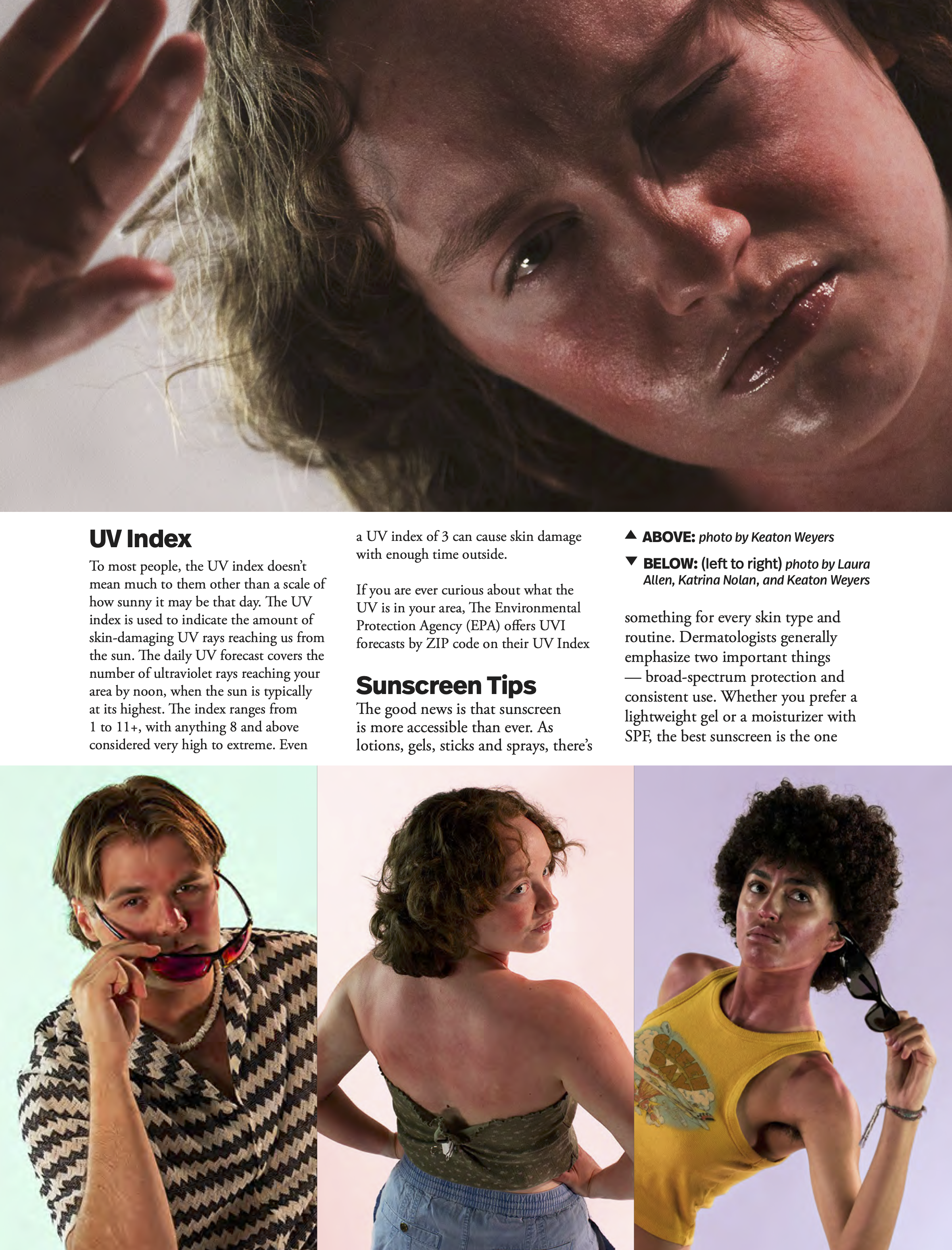
story by Natalie Anderson, photos by Katrina Nolan & Keaton Weyers & Laura Allen, design by Katrina Nolan, contributions by Thea Batch
Do you apply sunscreen every day? Whether it is 70° degrees and sunny or a windy and overcast Ellensburg day, UV radiation can affect your skin.
Most people think of sunscreen as a summer accessory— something to use while on vacation or floating down a stream in a heatwave. But according to the Centers for Disease Control and Prevention (CDC), most skin cancers are caused by long-term exposure to ultraviolet (UV) light from the sun, not just the occasional red sunburn.



















The common habit of skipping sunscreen is exactly what health experts warn against. With sunscreen available in every form from lotions to sprays and growing confusion about what really works, the PULSE explores how students use (or don’t use) sunscreen and what science says about effectiveness and protection.
When asked how often they apply, Caidence Meadors, a first-year chemistry major, says, “I used to apply sunscreen every day, because of my makeup routine … it helped with my skin.”
Meadors isn’t alone. For a lot of students sunscreen isn’t about science — it’s about habit. If it’s already sitting on the bathroom counter, it gets used. If not, it’s easy to forget. Many people use sunscreen for specific moments, like hiking or going to the lake, instead of the everyday walk to class. But UV exposure doesn’t follow the academic calendar. Even mild, cloudy days contribute to long-term skin changes, which is why experts stress steady, daily protection rather than reacting only when the sun feels strong.
When surveyed outside of the SURC, many students reported not understanding the importance of sunscreen. Many students said they do not apply sunscreen daily, let alone when the UV is high. “I would apply sometimes,” says Luka Webber, a first-year history education major, “but I had no idea that everyday sunscreen made any difference.”
Health experts say consistency matters more than anything. UV radiation contributes to gradual skin damage over time, even in small doses. This doesn’t always show immediate effects, which may be why it is easy to ignore. But over weeks, months and years, that exposure adds up. Most of the time, it shows up years later as wrinkles, dark spots or more serious skin conditions like cancer.
UV Index
To most people, the UV index doesn’t mean much to them other than a scale of how sunny it may be that day. However, the UV index is used to indicate the amount of skin-damaging UV rays reaching us from the sun. The daily UV forecast covers the number of ultraviolet rays reaching your area by noon, when the sun is typically at its highest. The index ranges from 1 to 11+, with anything 8 and above considered very high to extreme. Even a UV index of 3 can cause skin damage with enough time outside. If you are ever curious about what the UV is in your area, The Environmental Protection Agency (EPA) offers UVI forecasts by ZIP code on their UV Index page.



Sunscreen Tips
The good news is that sunscreen is more accessible than ever. As lotions, gels, sticks and sprays, there’s something for every skin type and routine. Dermatologists generally emphasize two important things — broad‑spectrum protection and consistent use. Whether you prefer a lightweight gel or a moisturizer with SPF, the best sunscreen is the one you’ll actually wear. “I used the CeraVe invisible mineral sunscreen. It has a very nice clear coat and doesn’t white cast for me,” says Meadors.
For students trying to build the habit, keeping sunscreen somewhere visible can be a subtle reminder to apply. Next to your toothbrush, on your desk or in your backpack — reapplying doesn’t have to be complicated. Stick sunscreens and sprays make it easy to refresh protection between classes. Small changes like these can make sunscreen feel less like a chore and more like a normal part of getting ready.
Reapplication and Year-Round Sunscreen Use
According to Meghanne Barbara, program coordinator of the Office of Health Promotion, the biggest key to sunscreen is simply making it part of your routine. “Individuals should liberally apply sunscreen at least every two hours to maintain consistent protection,” she says, noting that reapplication should happen even sooner.“If you’re swimming, sweating heavily, or toweling off,” Barbara says, she also recommends choosing a broad‑spectrum sunscreen with “an SPF of at least 15” and giving it about 15 minutes to settle into your skin before heading outside.
Sunscreen isn’t just a summer thing, Barbara says that, “UV rays can reach you on cloudy, cool days and they reflect off surfaces like water, cement, sand and snow.” That means Ellensburg’s windy, overcast days aren’t giving anyone a free pass. To make the habit easier, she suggests carrying a spray or stick sunscreen, setting reminders during long outdoor days and even making reapplication a group effort. “Keep your friends accountable and make re‑applying a group activity,” she says. And for anyone who thinks sunscreen is only for lighter skin tones, Barbara is clear, “Sunscreen is for everyone, regardless of skin tone … melanin isn’t enough on its own to protect from skin damage.”
Now, as it may be clear as day for some, but using sunscreen is not limited to only hot days. It is one of the quickest and simplest ways to protect your skin — through clouds and snow. Applying sunscreen is a quick tool to help prevent all sorts of skin damage and cancers. So, even on days when the sun feels far away it might be a good time to think about applying sunscreen, or laying down a towel and getting that tan.