Beyond The 'Burg — Study Abroad with CWU
story by Meisner Dunlap and Owen Schuettpelz, design by Alex Littman
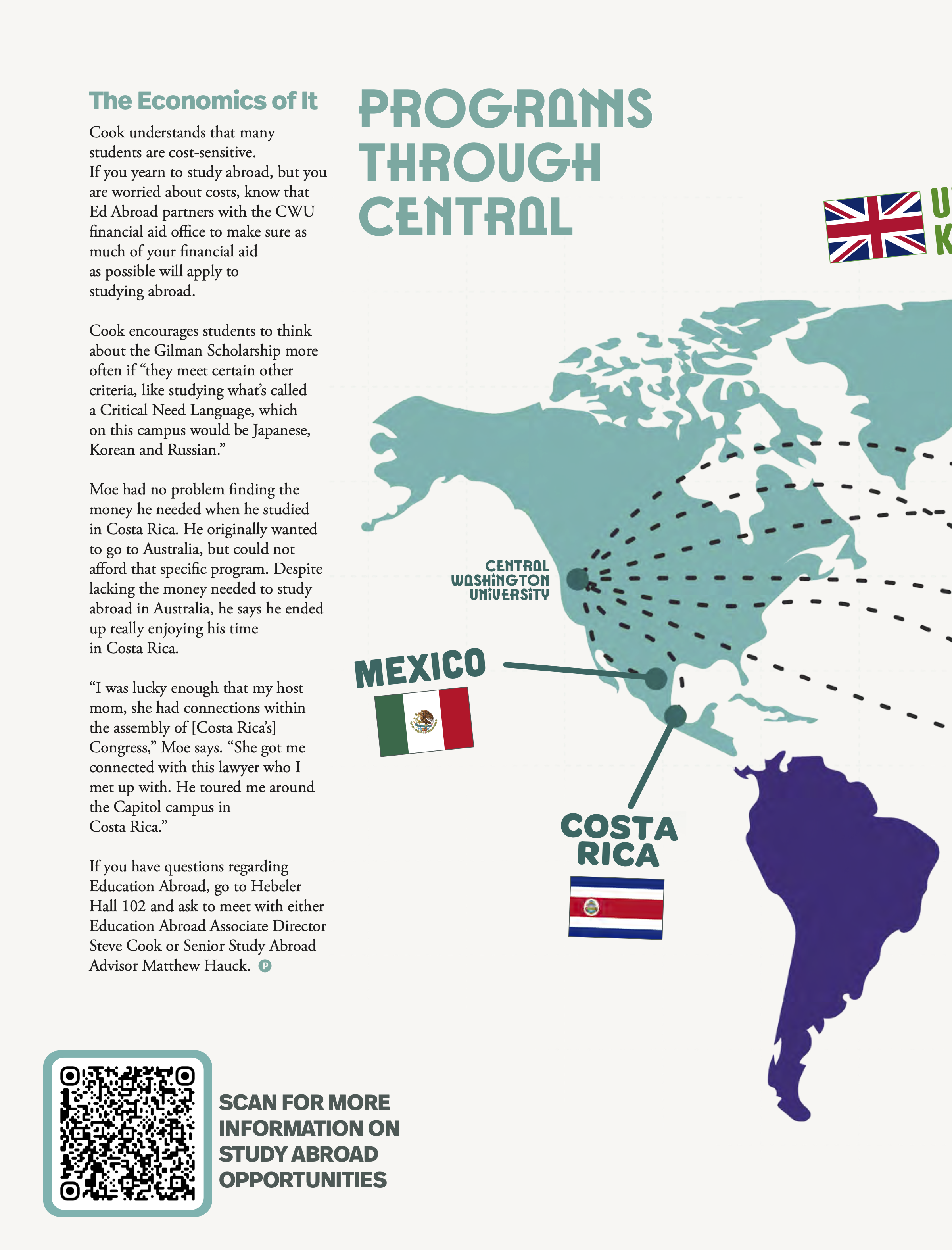
When Mahmoud Alkhazraji, an Iraqi-born CWU student who goes by “Moe,” was in Costa Rica as an exchange student in the fall of 2025, he was surprised by how much Costa Rica felt like home to him.
"It's a very unique country. It's me,” Moe says. “It was all green, lush forest, Spanish-speaking, but everything else, the way the streets looked, the way people looked, just everything, the restaurants, the cuisine, ... a lot of the things reminded me of Iraq."
Moe is one of several dozens of CWU students who study abroad annually.
CWU’s Education Abroad department offers students with various opportunities to study abroad. The organization oversees multiple programs, including third-party programs, exchanges, international internships, faculty-directed programs and research abroad opportunities.
Education Abroad works with students who want to study abroad as well as international students coming to CWU.
Wide variety of study abroad options
Over time, Education Abroad has added new options to its organization. “We don’t limit opportunities for students,” Education Abroad Associate Director Steve Cook says. “I can’t give you a round number [of how many programs we can offer each year] because, to a certain degree, they’re infinite outside of certain things, mostly related to safety.”
The time duration of each program type varies. Some international students study at CWU for a quarter, others for only a few weeks or for a year. Cook would tell you, as CWU students, that you can do the same in other countries.
Student experiences
Spreading your wings and leaving the nest is something that all college students can relate to. Taking the leap and leaving home for what might be your first time can be challenging, but it is also an exciting adventure. For exchange students, the adventure is naturally amplified.
Studying abroad allows students to go beyond their immediate surroundings and cultural norms, and learn about rich cultures and peoples that they might not have had interaction with otherwise. You might find that in learning about others, you’ll learn about yourself, too.
“I've lived in Scotland my whole life, I've lived in the same house all my life,” says Emily Hughes, a second-year sports management major, “but I felt like I wanted to love myself for a bit and spread my wings.”
“[I wanted to] see what real life is like in a different country, how you actually live in the US.” Hughes says, “It's a lot more different than I thought it was going to be, but I've loved it.” Taking the plunge seems hard at first, but once students take that first step, they never regret it.
Studying abroad offers the unique experience of being able to immerse yourself in different cultures, learning much more than you ever would have been able to otherwise. Not only are you able to learn about other cultures, but you’re also given the unique opportunity to learn about your own cultural identity as well.
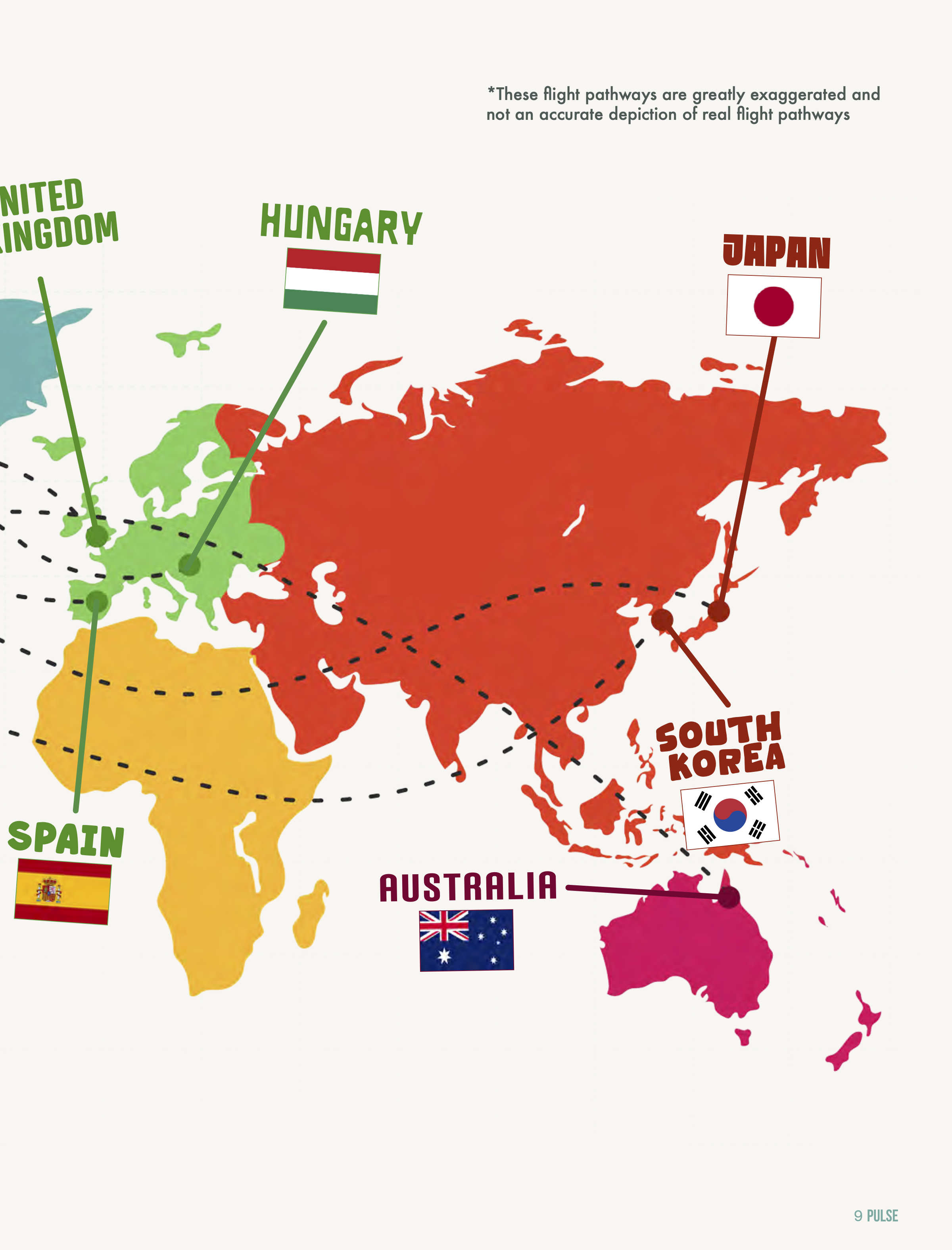
“I've always been Asian American, but I feel like after living in Japan, I've been focusing a little bit more on the Asian in my identity,” says EllaBeth Crawford, a fourth-year Japanese language student. “I've picked up the daily mannerisms of Japanese people, and I incorporate that into my own life.”
Of course, there can be challenges as well. The biggest struggle for international students is the distance between them and home. Having your friends and family thousands of miles and a few time zones away is not always easy to handle. “Trying to stay in contact with my family back home, that's probably been the biggest difference, especially being quite homesick at the start,” says Hughes.
However, Hughes adds, “Luckily, I've met some great people here and they've become a good support system for me.”
When asked for any advice they'd give to students considering studying abroad, resoundingly, the answer from exchange students is to give it a try.
“It's genuinely the best decision I've ever made. I would do it over and over and over if I could,” says Hughes.
Crawford says, “You can always get that money, the thousands of dollars it takes, but you'll never be able to say, I studied abroad when I was young.”
Third-party sponsored and exchange programs
A third-party program sponsor is an external institution that operates programs specifically for college students looking to study overseas. In Cook’s words, they “provide students a wider variety of programs they can participate in, both in terms of geographic location, academic areas and even program duration.”
CWU Education Abroad works with about 11 or 12 exchange partners across about five countries. “A lot of the students who go abroad on those programs, or programs in general, are drawn to East Asia, Japan and South Korea in particular,” Senior Study Abroad Advisor Hauck says. But students who are not accepted to exchanges can still apply to third-party programs at universities CWU partners with directly.
Internship abroad versus faculty-directed programs
If you want a hands-on, practical experience in a foreign country, then study abroad internships are right for you. “The sponsors find employers who can accommodate the students’ academic and professional goals. Most students do internships in the summer,” Hauck says.
Faculty-directed programs are CWU classes with an embedded component consisting of overseas travel. For example, Josh Nelson-Ichido, an assistant professor for the Department of Communication, takes his students to Japan for about two weeks for part of his Intercultural Communication class.
“This program offers students a taste of what’s possible,” Nelson-Ichido says. “Many students assume Education Abroad is only for language students, but the reality is everyone can benefit from an experience abroad and joining a faculty-directed program like this one is a great way to ignite one’s passion to explore more. Every year, we have students come back from this trip and immediately start seeking more opportunities to go abroad.”
The economics of it
Cook understands that many students are cost-sensitive. If you yearn to study abroad, but you are worried about costs, know that Ed Abroad partners with the CWU financial aid office to make sure as much of your financial aid as possible will apply to studying abroad.
Cook encourages students to think about the Gilman Scholarship more often if “they meet certain other criteria, like studying what’s called a Critical Need Language, which on this campus would be Japanese, Korean and Russian.”
Moe had no problem finding the money he needed when he studied in Costa Rica. He originally wanted to go to Australia, but could not afford that specific program. Despite lacking the money needed to study abroad in Australia, he says he ended up really enjoying his time in Costa Rica.
“I was lucky enough that my host mom, she had connections within the assembly of [Costa Rica’s] Congress,” Moe says. “She got me connected with this lawyer who I met up with. He toured me around the Capitol campus in Costa Rica.”
If you have questions regarding Education Abroad, go to Hebeler Hall 102 and ask to meet with either Education Abroad Associate Director Steve Cook or Senior Study Abroad Advisor Matthew Hauck.