
Cool Cat: Vijay Singh
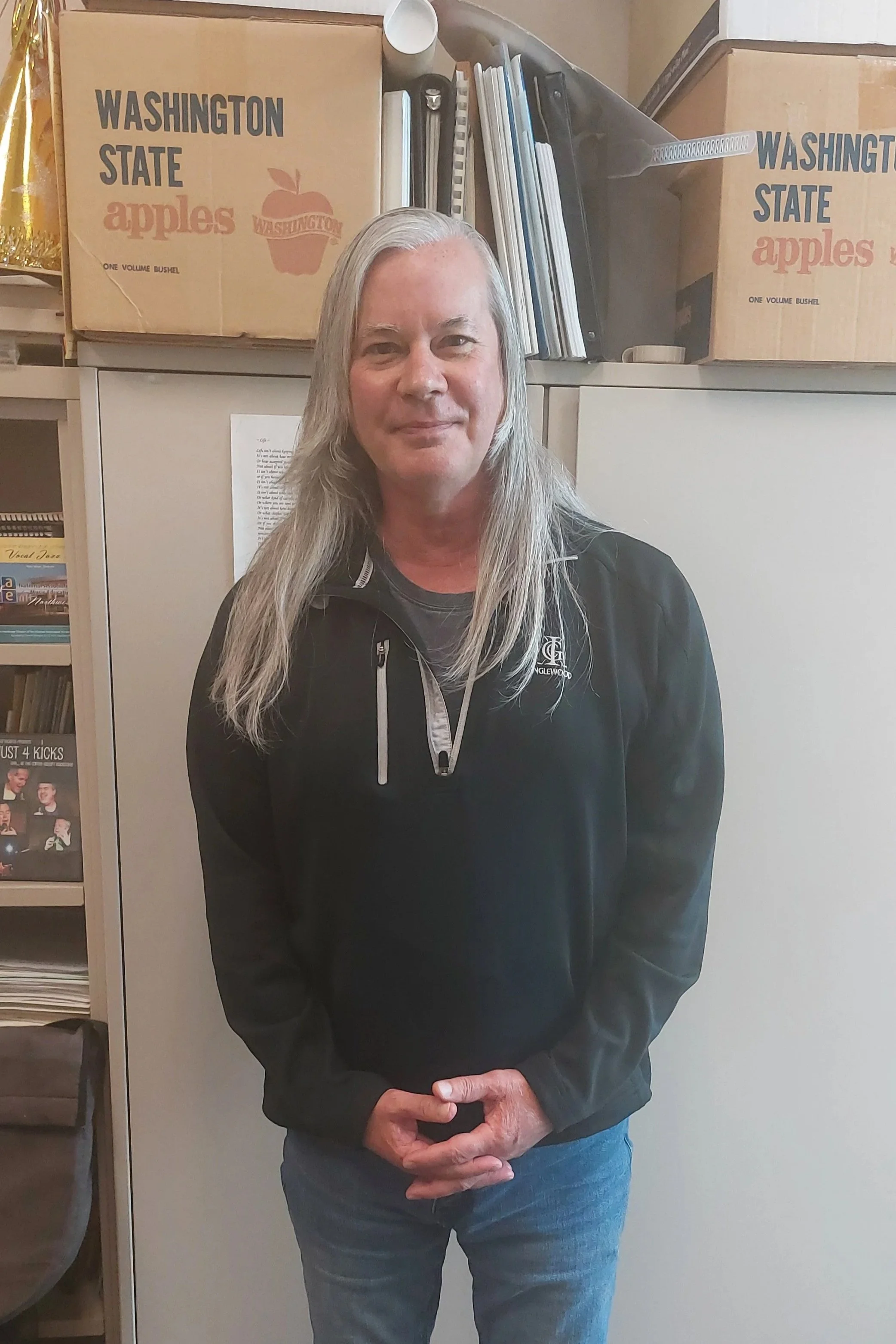
Professor of Music Vijay Singh was granted tenure and a full professor position after 9 years at Central Washington University (CWU). They have maintained their status as professor of music for 26 years.
Professor Singh is a beloved instructor within the music department known for their humor, positivity and dedication to their craft. They strive for all of their students to achieve excellence in musicality and become the best musicians and educators.
Q: What is your position at CWU?
I have a very unique position in this department. I have one of two hybrid positions. So most of my colleagues are here for a very specific job that aligns with their areas of specialization. My position, when they created it, they decided to make a hybrid position that was half jazz, both instrumental and vocal, and half choral vocal/music ed, which was really unusual at the time because in most academic university situations, the majority of people are specialists. That's kind of the tradition of academia.
Q: What was your career before coming to CWU?
In my position, I came from a public school background, so I taught middle school and high school. And then after doing that and going back to grad school, I got into being a full-time performer, a freelance performer for almost 12 years, while I was teaching on the side as an adjunct. And as fun as that was, and I learned tremendous amounts about that, being a professional performer and being on the road, it was increasingly more difficult when my wife and I decided to have a family.
So the last couple of years that I was doing the freelance thing and teaching part-time, my daughter was born, and I would be sometimes on the road for four to six weeks at a time, and I'd have to leave my poor wife with a little baby, which is tough. I would go off and do the gig. Then, when I'd come back, this really hit home for me because I'd come back (pre-9/11), they'd meet me at the airport. I would go to my daughter, and she didn't know who I was because little kids are products of their day-to-day interactions.
So I decided that I love teaching, and I thought maybe it's time for me to get back into a normal job, being in one place, regular benefits and a salary as opposed to the crazy life of a freelancer. I think a lot of students think that's really a glamorous lifestyle. It can be, but it's also not as glamorous as maybe what a lot of people think.
Q: How did you become a professor at CWU?
So around that time, I got hired to do a gig with the Yakima Symphony Orchestra. And a lot of central professors play in the Yakima Symphony. A bunch of them cornered me backstage after the gig. I was hired as one of the bass vocal soloists. And they said, " Hey, so-and-so is retiring, and we're going to restructure this job at Central and we're going to do it. It's going to be kind of an unusual hybrid job, half jazz, half choral, music ed. Would you be interested in applying?” And I thought, this could be really different. I was, like I said, it was kind of getting tired of being on the road all the time. So I applied, and the rest is that they offered me the job, and I took it. And we've been here ever since for the last 26 years.
Q: How has the COVID-19 pandemic impacted the music program?
Post-COVID, a lot of music programs got hit really hard. A lot of education programs got hit really hard. And enrollment numbers across the entire US have been affected by COVID and by the recovery from COVID and everything else. Central's no different. They're dealing with the same issues.
So recruitment and retention of students and building the numbers back up to levels that are sustainable is, I think, every university in the US is struggling with. We're really blessed here. Believe it or not, after we got through the COVID years, our enrollment numbers went down and everyone was like, okay, we've got to rebuild. But our rebuilding happened at a much quicker pace than our sister institutions.
Our numbers here surpass the College of Arts and Humanities and the university as a whole. So that tells us that people who want to be musicians and who come here to be in our ensembles and take our classes and be educated in music, they're coming here because of all of that stuff. Whereas they're not going to some of the other institutions in the state that offer the same type of curriculum.
So that tells me something about the perception and the quality. The students are very kind. It's a welcoming environment as opposed to, no, just stay in our little territory. A lot of music programs in academia are very territorial, unfortunately, and they're very selective. So they're not as inclusive. They only want the top people who do this and that. That's kind of the nature of the music business. I get that. But I really love the fact that Central has a very welcoming and a very nurturing type of environment.
Q: Why do you use a variety of music exercises? What is the importance of these exercises?
All of these exercises that we do at the beginning of class, like the vocalizing, the ear training, the sight reading, the conducting, all of that stuff is me giving you guys the tools that will allow you to become better musicians at your own level and your own pace. I didn't use to do as much of that when I first got here, and I kind of regret it because over the years I've become a much better teacher.
When I first got here, I was coming off of being a professional performer. Even though I had an educational background, my mindset was performer, conductor and soloist. I didn't make my students do a lot of the foundational building-block stuff that I now do. We would concentrate more on the pieces of music from a performer's standpoint. I found that even though that was fine, my job here was to cultivate and teach future music educators.
Q: How do you choose the pieces for each quarter?
Chorale is a non-audition group, and anyone is welcome. I never know quarter to quarter what I'm going to have to work with. I can pretty much anticipate that once we get through the fall quarter, if people enjoy what they did in the fall quarter. They want to come back. I don't ask people this in class, but I kind of have an idea that, if you had a good time, you're planning on coming back and singing for the next two quarters. That gives me an idea about approximate numbers that I might have in each section.
The hardest thing for me is that I have to pick the music weeks or months in advance to get it through the library. And so there have been quarters, it doesn't happen very often, but there have been quarters where, for example, I had like only four tenors. So I'd have like 8 basses, 4 tenors, 14 sopranos, and 9 altos. I can't turn people away, but I have to be able to take all of those different things, and there's some innate balance issues. Now, how do I solve the fact that there's only four tenors? How do I adjust?
There was one year, this has only happened once in the 26 years I was here, but there was one year that I programmed an entire quarter of a cappella music. I wanted it to be a thematic thing. So I picked five pieces that were all a cappella, no accompaniment. And lo and behold, that one quarter, it was winter quarter, I had only six basses. You know how hard it is to do acapella music with only six basses? Yeah. It's really hard.
Now, if I also conduct some audition groups, and since they're audition, I know exactly who's in the group, and I say, okay, I'm gonna have 5 basses, 4 tenors, five altos and four sopranos. And if you're in the group and you've auditioned and this is what you're expected to do, then it gives me as the conductor, like, oh yeah, okay, now I know what I've got. I've got this number of people, and I've got this kind of balance and we're ready to go. That's a lot easier to program versus a non-audition group, where you never know.
Q: How did you choose the pieces for this quarter?
So the pieces that I picked for this last quarter, this spring, I made the decision at the end of fall quarter, and I thought, wow, if I can get a bunch of these people back and we can maintain this, I think that we could do some of this more advanced music in the spring. And luckily, it's worked out that way. Yeah, but I'd say that for me, that's probably the biggest challenge for a group like Chorale, is I just never know what I'm going to have to work with. The same thing with this year with the accompanist situation. I didn't have an assigned collaborative pianist in the fall.
So I was like, oh, okay, I got to make that work. And in the wintertime, I got literally a last-minute notice that we'd have Dr. Vargas. I was like, hallelujah, this is really great. So now I can pick these pieces that have a hard piano part. Now, because Dr. Vargas was in his last week … So unfortunately, we were like, okay, so I've programmed two of the four pieces with piano. And oh no, what do I do? I mean, this is like I was wrestling with this literally for the last two weeks.
Okay, do I assign the Handle [“Your Voices Tune”] and “Upon A Bank With Roses” to Soren [the assigned graduate student choral conductor for spring quarter]? Do I force him to learn to conduct those pieces because that means that I'd have to play, which is what I've had to do in a couple of rehearsals? And I'm willing to do that, but those are the things that happen literally mid-term. And I'm like, going, oh my gosh, now what do I do? I have to make this work. We've already learned this. The concert is 3 weeks away.
Luckily, we were able to hire Dr. Carlson to come in, and it's so nice to be able to have that luxury. But that luxury doesn't always happen. So that's another challenge for me as the conductor and director. My job is to make it work no matter what.
Q: What advice would you like to give to students who come into the program?
Be open-minded. Be willing to try new things. Commit to excellence at every level, and realize that we are here to discover things together. I don't expect people to be perfect. I do expect them to give a very, very concentrated effort on a daily and weekly basis for improvement. And I will be there to support, nurture and guide every single week with the idea that the finite number of nine weeks is each quarter's journey.
Q: What would you say to non-music majors who are hesitant to come into the choir program?
I would say give it a shot. You have nothing to lose. We're not going to be judgmental just because you're not a music major. In fact, all of my colleagues here, all of us who are ensemble directors, all of our ensembles at the university are open to anyone.